
Download a summary of all the key points
Use this workbook to guide you through proven, practical steps to become more productive and achieve excellence in life.
and Achieving Excellence
Do you want to get more out of life? Be more successful at work and all that you do? Feel good about yourself? You can.
Excellence is, “Being the best you can be.” You can make progress in that direction by becoming more productive in life, at work, and in your activities. The good news is that productivity is a decision, and you can get there one choice at a time.
There are universal principles that will help, and they’re both proven and timeless. In this Online Toolkit are some of the best techniques from the worlds of personal and professional development, wellness, spirituality, psychology, and business.
These balanced approaches worked for others and can work for you. You can become more productive, one step at a time.
This Online Toolkit will help you become more productive a step at a time. Start by watching this short opening video.
In each lesson, simply watch the one-minute video, listen to or read the content, and review the featured key points.
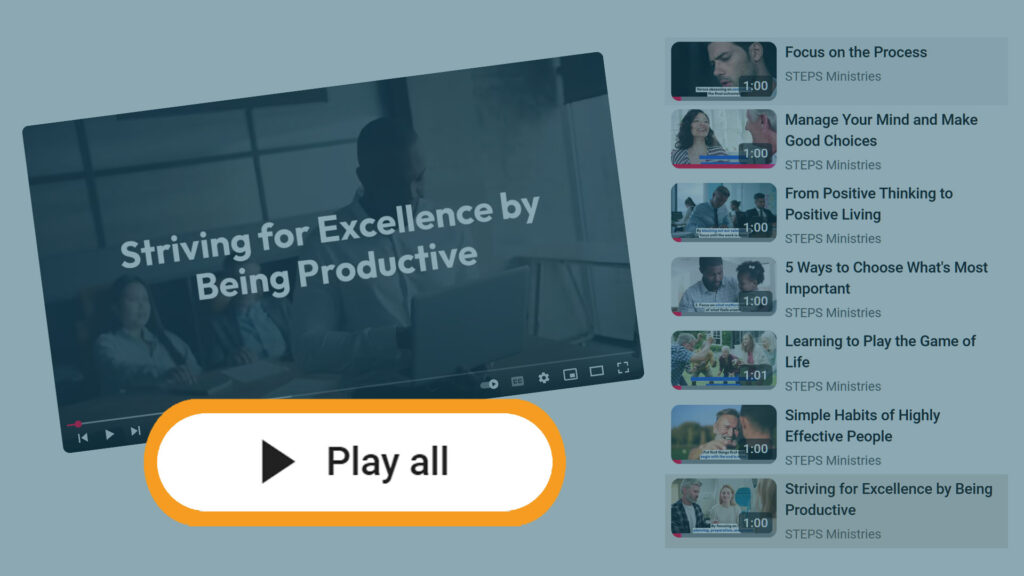
See the summary resources at the bottom of the page. You can download or print the workbook to use as you go along. Click “Play All” if you want to see all of the videos at once.
If you prefer to check out a particular topic first, just scan the page below and pick one of the lessons to go through.
We all desire success and want to do our best and feel good about ourselves. Striving for excellence by being productive helps us achieve those goals, and it’s within our control!
Excellence is not found by obsessing on perfection, controlling outcomes, or searching for recognition but by doing our best, aiming for progress, and choosing to be productive.
We can become more productive by working on our effectiveness, efficiency, and effort:
Effectiveness is working on what’s most important to achieve our goals – We become more effective in 3 ways: Planning to work on the right things; Preparation to be equipped to work; People by working well with others.
Efficiency is working in an organized way without wasting time or energy – We can increase our efficiency in 3 ways when we: Manage our priorities by working smart; Manage our time by directing our work; Manage our resources by choosing to work wisely.
Effort is getting started, doing our best, and taking the next right steps – We can show effort in 3 ways: Be the best we can be by working hard all of the time; Show personal leadership in doing our best work; Do whatever it takes by working with all our heart.
Striving for excellence by being productive is a journey, not a destination, and we focus on progress versus perfection. We do our best and take it one choice and one step at a time.
After seeing the short video and article, answer the questions below:
Effectiveness
Effectiveness helps us succeed in work, activities, relationships, and life. It equips us to get results, meet goals, and find fulfillment. In other words, we get more things done better.
Stephen Covey’s 7 habits of highly effective people will help us improve, and we can align those principles to 3 areas of personal development:
Planning: Prioritize working on the right things.
Preparation: Equip ourselves to work effectively.
People: Always practice working well with others.
Most wisdom is not new but familiar, simple, and trustworthy, and many habits of highly effective people are universal and timeless. They work—if we take the steps to use them.
After seeing the short video and article above, answer the questions below:
Depending on how big a sports fan you are, you may watch dozens of football games over the years. Life is full of lessons, and we can even learn a lot from the game of football.
Planning: Developing a good game plan increases our odds of success.
Our plan should operate within the rules and utilize our skills, and sometimes we need to adjust our plan when circumstances change.
Preparation: The pursuit of excellence requires intentional preparation.
Getting in shape, physically and mentally, helps us in the long run, and mastering the fundamentals leads to success. We move toward excellence by focusing on what we can control and with consistent practice.
People: Good collaboration and teamwork help us live more effectively.
Successful teams are made up of people with different skills and personalities who support each other and work well together. The best teams are those where players mutually commit to each other’s success.
In addition to focusing on planning, preparation, and people, being effective as a person or a team involves developing the resilience to deal with setbacks and persevere through challenges, giving us 4 useful reminders for playing both football and the game of life.
After seeing the short video and article above, answer the questions below:
Living effectively includes focusing on what’s most important in life.
But, too often, we get distracted or just react to our circumstances without thinking about the big picture. Instead, we need to pause and intentionally choose what matters most.
Choose to use our time well versus wasting it: Every time we move on to another task, we should be intentional—rather than impulsive or compulsive—about what we do next.
Choose what’s important rather than urgent: Rather than being captive to the tyranny of the urgent, we need to focus on long-term goals—ideally with a life plan—to set priorities.
Choose to do something meaningful each day: Every day, we can choose to do things that are meaningful such as surrendering to God, transforming ourselves, or serving others.
Choose the right thing and not the easy thing: It’s hard to know sometimes when to let go of something or act courageously, but the Serenity Prayer can help us choose wisely.
Choose something great instead of just good: We can spend our entire lives staying busy on pretty good things, but it’s better to seek those great things that we are called to do.
Too often in life, we choose to do things that are urgent, trivial, or easy rather than what is important, meaningful, or right. Other times, we waste our time or do nothing. But life doesn’t have to be that way, and we can choose differently. What will you choose?
After seeing the short video and article above, answer the questions below:
EFFICIENCY
Positive thinking begins with a deliberate choice to control our thoughts and not allow negative thinking to dominate our internal conversations. A powerful tool to think more positively is to “manage our mind” using the three steps of “Pause, Evaluate, Choose.”
Efficiency is being organized and doing things the best way. Managing our mind helps us be efficient as we learn to manage our priorities, manage our time, and manage our resources.
Manage our priorities: This turns positive thinking into positive planning as we pause to consider the “WHY” that are the desired benefits; evaluate the “WHAT” or the pros and cons of each option; and choose the “HOW” which are actions to achieve our goals.
Manage our time: When we translate our plans into positive scheduling by using time blocking to pause to schedule key activities; avoid procrastination and evaluate distractions; and stay focused to choose to keep working for the committed timeframe.
Manage our resources: As we apply time and resources to positive doing, we can use positive believing to pause to glorify God in all we do; positive spending to evaluate how to steward our resources; and positive living to choose to enthusiastically get into action.
We can learn to live more efficiently by managing our mind to translate positive thinking into positive living, which we can then continue doing one thought and one step at a time.
After seeing the short video and article above, answer the questions below:
Living efficiently involves doing things smarter and more intentionally. It means managing our priorities, time, and resources wisely. And it starts by learning to manage our mind.
We can improve how we think and make choices to lessen distractions and stay on track in life. Science shows that we can even improve our brain—what is known as neuroplasticity. By changing how we think, we build better habits and manage our lives more efficiently.
A simple process to turn neuroscience into positive living is: “Pause, Evaluate, Choose.”
Pause: Interrupt the situation to increase our awareness of what is happening. Step back to gather information by observing any emotions, triggers, or temptations influencing us.
Evaluate: Engage our brain to assess the situation. Think about the long-term, big picture. Treat emotions as merely “indicator lights” to consider and weigh pros and cons of options.
Choose: Then, and only then, decide on the next right step. Make a thoughtful, intentional choice that will lead us in a positive direction. Take that step and then assess the results.
Learning to mange our mind is a powerful tool. For example, we can use it to help deal with temptations, cope with emotions, manage our time, and make better decisions.
With practice, it will become more natural to pause and evaluate situations and then make more intentional choices. One thought—one choice—at a time, we can live life better.
After seeing the short video and article above, answer the questions below:
EFFORT
Famous football coach Nick Saban helped popularize the term, “Focus on the process.” In both the sports world and in our lives, that is great advice. But how do we do it? By focusing on the fundamentals, what we can control, and giving our best effort.
Focus on the fundamentals: Work on the basic skills that contribute to performance, because success comes from doing the small things consistently and well. Over and over.
Focus on what we can control: We can waste our energy on things we cannot control, such as outcomes, or we can choose to work on those things we have the power to change.
Focus on giving our best effort: Choosing to do our best includes committing to hard work. Concentrated effort helps us make progress toward our goals and find excellence.
In life, it’s the journey that’s important, and every journey begins with a first step. We can’t worry about end results, and it’s better to just keep doing the next right thing instead. It’s about what we can control, so we should focus on the things we have the ability to change.
Then, every minute of every day, keep taking it one step at a time.
“Focus on the process” helps us remember to concentrate primarily on the fundamentals, what we can control, and giving our best effort. Because in football and in life, some things just work. Especially when we focus on the process.
After seeing the short video and article above, answer the questions below:
This article has a simple—but transformational—message: Take the next right steps.
Do something. Get into motion. Then do something else and take another step. See how things are going and move forward. Keep making progress by taking the next right steps:
If circumstances—or your inactivity or choices—are keeping you from the life you want, take the next right steps. Action creates momentum, and small steps mean progress.
If procrastination is holding you back, start with very small steps. If you feel sad, doing something can improve your outlook. If God seems distant, take a step of faith toward him.
Progress is about forward movement. The first step is the hardest, but getting in motion will help. Then, you can build momentum by taking one small step at a time. Such consistent progress can lead to life transformation. You can find the life you want one step at a time.
After seeing the short video and article above, answer the questions below:
It’s a noble goal to strive for excellence by being productive as long as we stay in balance. Each day, we can utilize strategies for being productive as we choose “what to do next.”
We also need to be balanced to engage in an ongoing wellness-based process that moves us toward greater well-being spiritually, emotionally, socially, mentally, and personally.
To achieve balance spiritually, we need to remember God is in control and is concerned about our heart more than the outcomes of our decisions.
We should consider everything we do as holy, stop giving into excessive worry, and be a good steward of our time.
After seeing the short video and article above, answer the questions below:
Use this workbook to guide you through proven, practical steps to become more productive and achieve excellence in life.